
The Climb AI Maturity Framework

Jim Rosser
Most AI projects don't fail at the model. They fail on the things around it: an outcome nobody defined, a cost curve nobody re-checked, a system nobody can correct once it goes wrong. We built this framework out of what we kept seeing in the field, the things teams skip early in an adoption and the things that surface later once the models and systems are actually running in production.
It gives you a set of questions to answer before you build, and a set to keep answering after you ship. It has six pillars, plus a working methodology for the people using AI day to day.
The full framework, with the detail behind each pillar, is in our white paper: Read the AI Maturity Framework
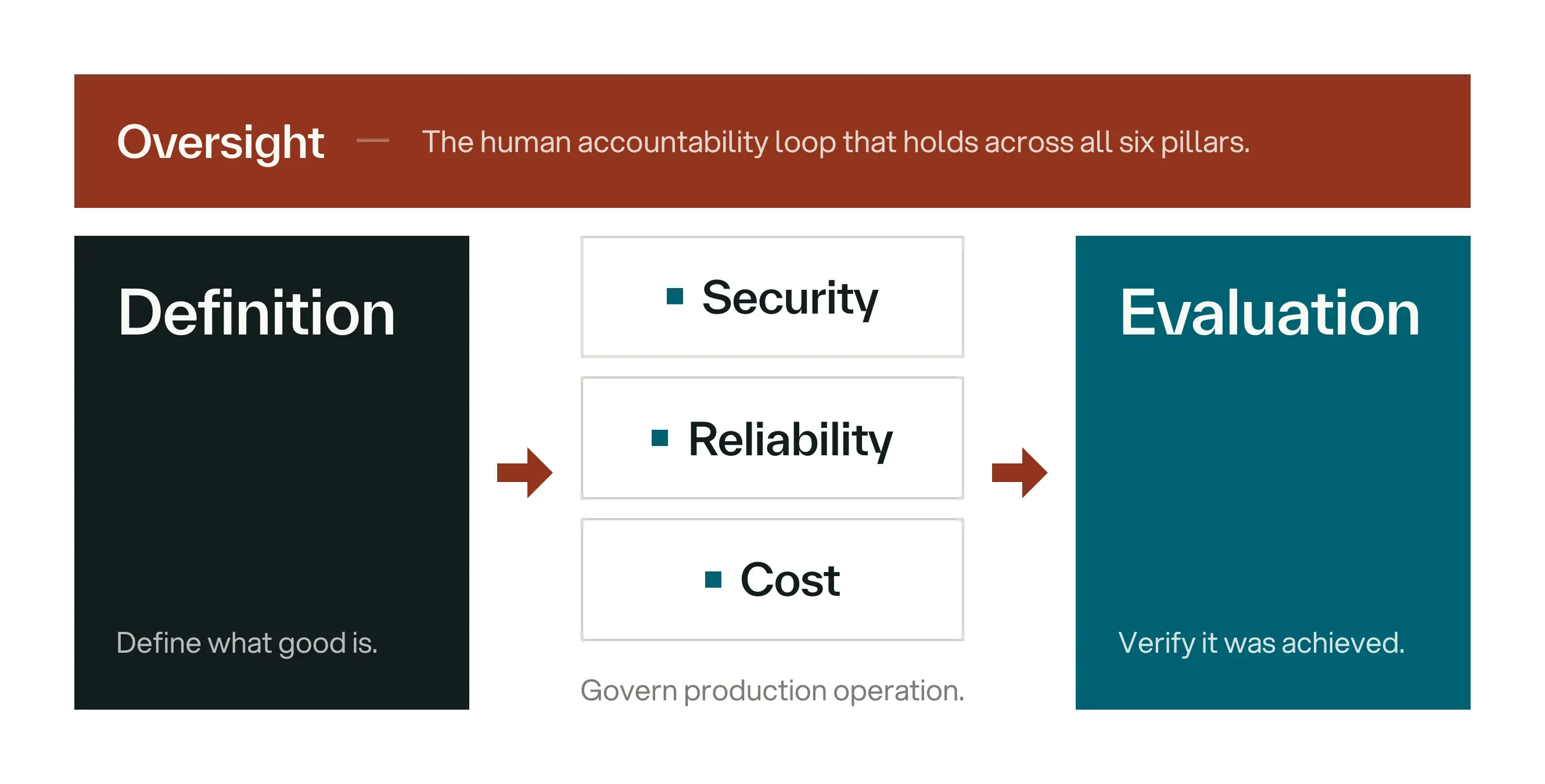
Definition: What are you building, who is it for, and what should it return?
Start with what you're building and who it's for. Not just a technical definition. Also the expected business outcome and the ROI you're underwriting. Define how you'll evaluate it before you build it. Without those definitions in place, everything downstream is guesswork.
Evaluation: How do you know the system is hitting the metrics you set?
Evaluation is the check on whether what you built, and what you keep running, is still hitting the KPIs you committed to. Service uptime is not the measure. The question is whether the business is actually better off, or whether the system is making things worse, or costing money and doing nothing at all.
Definition sits on the front end and evaluation sits on the back end. Both need to be revisited continuously, not signed off once.
Security: What happens when the inputs to your AI system are hostile?
You're running a non-deterministic system against a growing set of attacks, including supply chain attacks. Open source developers have shipped libraries containing injection attacks in their own code, in one case instructing any AI reading it to delete the entire codebase.
These systems have limited ability to tell the difference between what you told them to do and what a user or a third party added to the context. That makes security an active discipline, not a checkbox.
Reliability: How do you hold a non-deterministic system to a reliability standard?
You're asking a non-deterministic system for relatively deterministic output. The only way to get there is to define your reliability standards, then check and validate against them.
Trust is the real constraint. There have been enough false starts that buyers are skeptical by default, having seen systems that looked good in a demo and ended up costing more while returning little. Reliability work is how you earn back the benefit of the doubt.
Cost: Which architecture decisions set your long-term AI costs?
Cost is set largely by the architecture you choose at the start. One large foundation model, a few smaller ones, or a model you train yourself. If you have a lot of data, training your own can look like the obvious answer. Factor in that someone has to maintain and manage it long term.
Prices move and new models ship constantly. Re-evaluate the tradeoff on a schedule. That is one of the things your evaluation framework is for.
Oversight: Who can intervene when the system gets it wrong?
Computers aren't buying computers from computers. Humans are still accountable at the end of the line, which means humans stay in the loop: confirming the system did what you wanted, and having a clear way back in to correct it when it didn't.
How should your team work with AI day to day?
We use a simple methodology called DOT.
Direct. You're directing the AI toward a specific outcome.
Own. Whatever you produce yourself, or produce with AI on your behalf, is yours. That mindset matters.
Tune. This is the step that gets lost. You prompt, you get most of what you wanted, and you fix the parts you didn't. Write those corrections down as rules. Then retune the prompts, retune the context, and clean the data so it returns what you expect. Tuning is what makes the next run better instead of the same.
Where does this framework fit in your delivery process?
The six pillars work as a review gate. Run them before you greenlight a build, again before you put anything in front of users, and on a schedule once the system is live. Two of them, definition and evaluation, will tell you early whether a project is worth continuing. The other four are what keep it running once it is. They also give your engineers, your security team, and the people funding the work one source of truth to maximize alignment.
Climb Secures Growth Investment from RLH Equity Partners
Climb secures growth investment from RLH Equity Partners to expand Climb’s Databricks partnership, advance healthcare, life sciences and financial services solutions, and accelerate its agentic delivery operations framework.
 David Close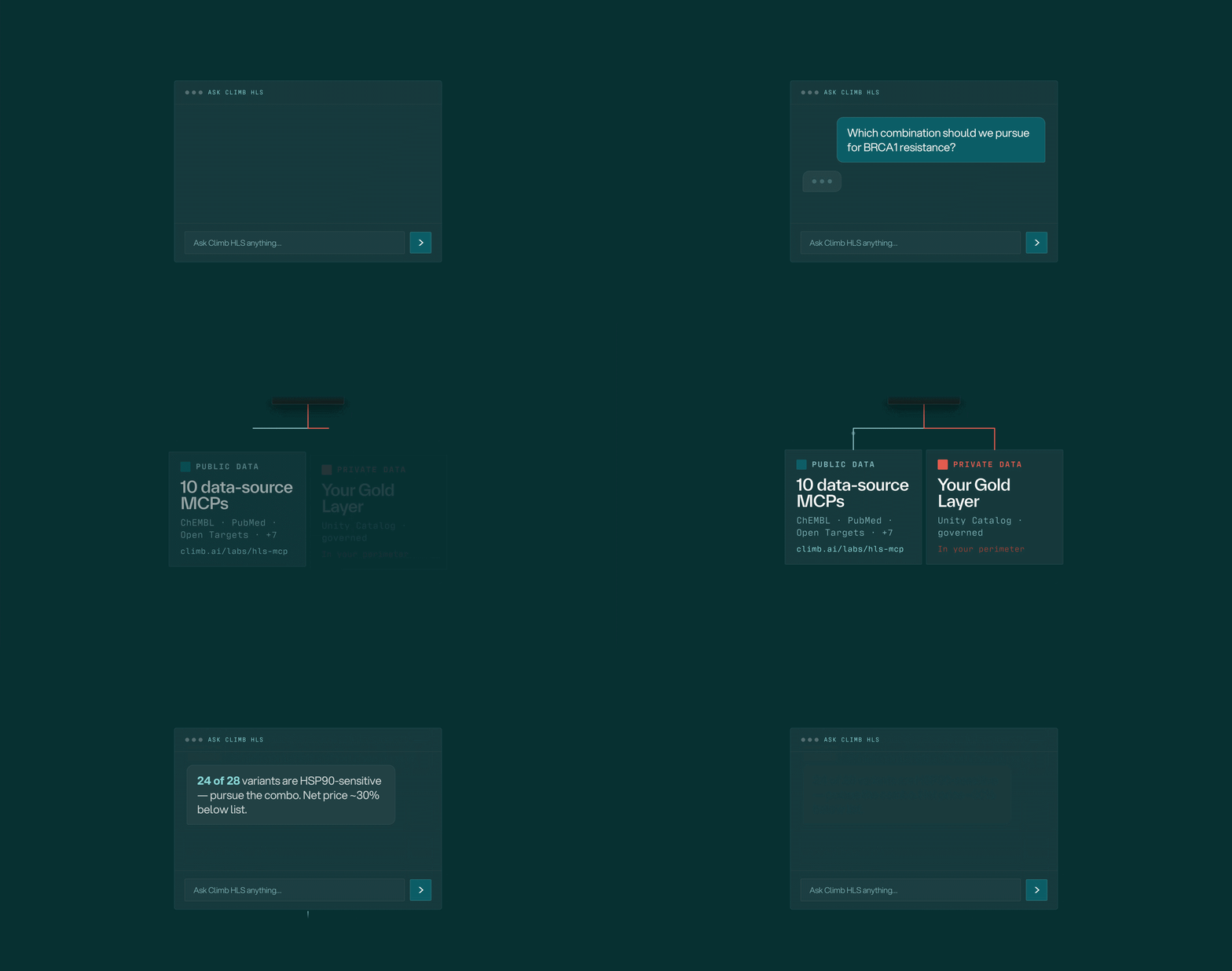
How Climb Partnered with Databricks to Build the Biomedical MCP Layer for Healthcare & Life Sciences in 30 Days
See how Climb built a suite of production-ready MCP servers for the most important open biomedical data sources, helping HLS teams connect AI agents to public data like FDA reports, clinical trials, and biomedical literature without weeks of integration work.
 Itai Weiss
Why your Tableau migration is also a governance migration.
Most teams plan a Tableau migration as a tool swap. The real opportunity is fixing the semantic layer that has been quietly breaking trust in the business.
Itai Weiss